Hunting Cabin Living Room Ideas — 15 Rustic Lodge Decor Designs That Actually Work
This post contains affiliate links. If you purchase through these links, I may earn a small commission at no extra cost to you.
Introduction
I’ve been in a lot of hunting cabins over the years. Some of them felt like magic the moment you walked in — warm, layered, full of character, like the walls had stories to tell. And some of them felt like a storage unit with a couch. The difference between those two experiences almost never came down to money. It came down to intentionality.
Here’s a stat that might surprise you: according to a National Association of Realtors report, cabins and rural properties with well-designed interior spaces sell for 15–20% more than comparable properties with dated or neglected interiors. People don’t just want a cabin. They want a cabin that feels like something. And the living room is where that feeling either gets made or lost.
Whether you’re decorating a hunting camp from scratch, refreshing an old cabin that needs new life, or just trying to make your weekend retreat feel as good as it looks from the outside — this guide has you covered. I’ve pulled together 15 hunting cabin living room ideas that are specific, achievable, and rooted in the kind of authentic outdoor lifestyle that Field & Ember Co. is all about. No Pinterest fluff. Just real ideas that work.
Table of Contents
What Makes a Great Hunting Cabin Living Room?
Before we get into the specific ideas, let’s talk about what separates a great cabin living room from a forgettable one. I’ve thought about this a lot, mostly because I’ve made nearly every mistake possible in my own spaces over the years.
Authenticity over theme. The best cabin living rooms don’t look like a hunting store threw up in them. Camo everything, antlers on every surface, deer prints on every pillow — that’s a theme, not a design. The best spaces feel like someone who genuinely lives the outdoor lifestyle decorated intentionally, with restraint. Less is almost always more.
Natural materials anchoring everything. Wood, stone, leather, linen, wool — these are the materials that make a cabin living room feel grounded and real. Anything synthetic or shiny tends to fight the space rather than work with it.
Warmth as the primary goal. Color palette, lighting, textiles — every decision should be evaluated through one lens: does this make the room feel warmer? Warm doesn’t mean hot. It means inviting, comfortable, and safe-feeling in a way that makes you want to stay.
Functionality built in. A hunting cabin living room gets used hard. Muddy boots near the door, wet gear drying by the fire, dogs on the furniture, kids running through after a day outside. Good design accounts for how the space actually gets used, not how it looks in a magazine photo.
1. Build the Room Around a Stone Fireplace
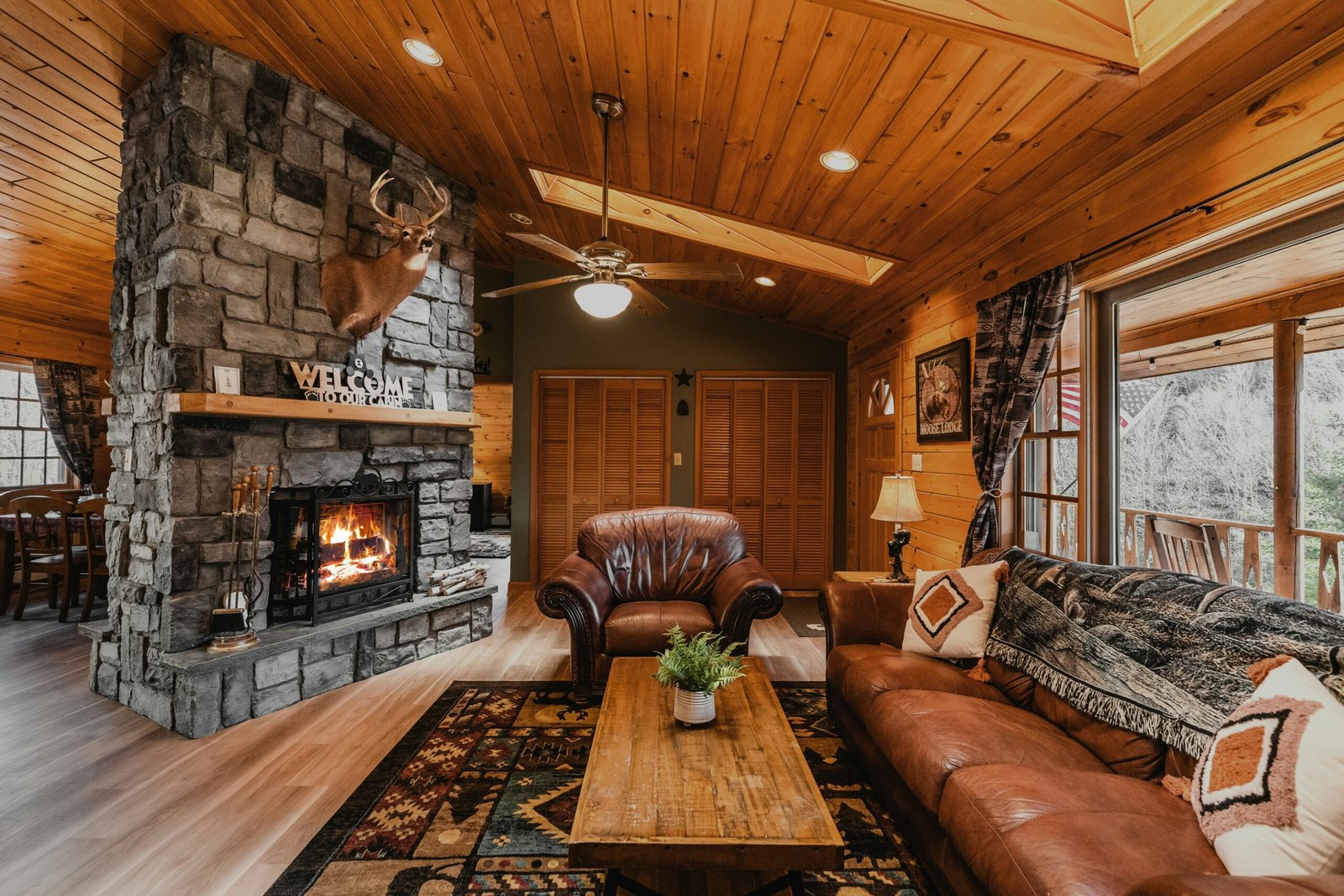
If your cabin has a stone fireplace — or if you’re planning one — everything else in the living room should flow from it. The fireplace is the anchor. It’s the reason people gather in that room, the source of warmth both literal and atmospheric, and the most visually dominant element in the space.
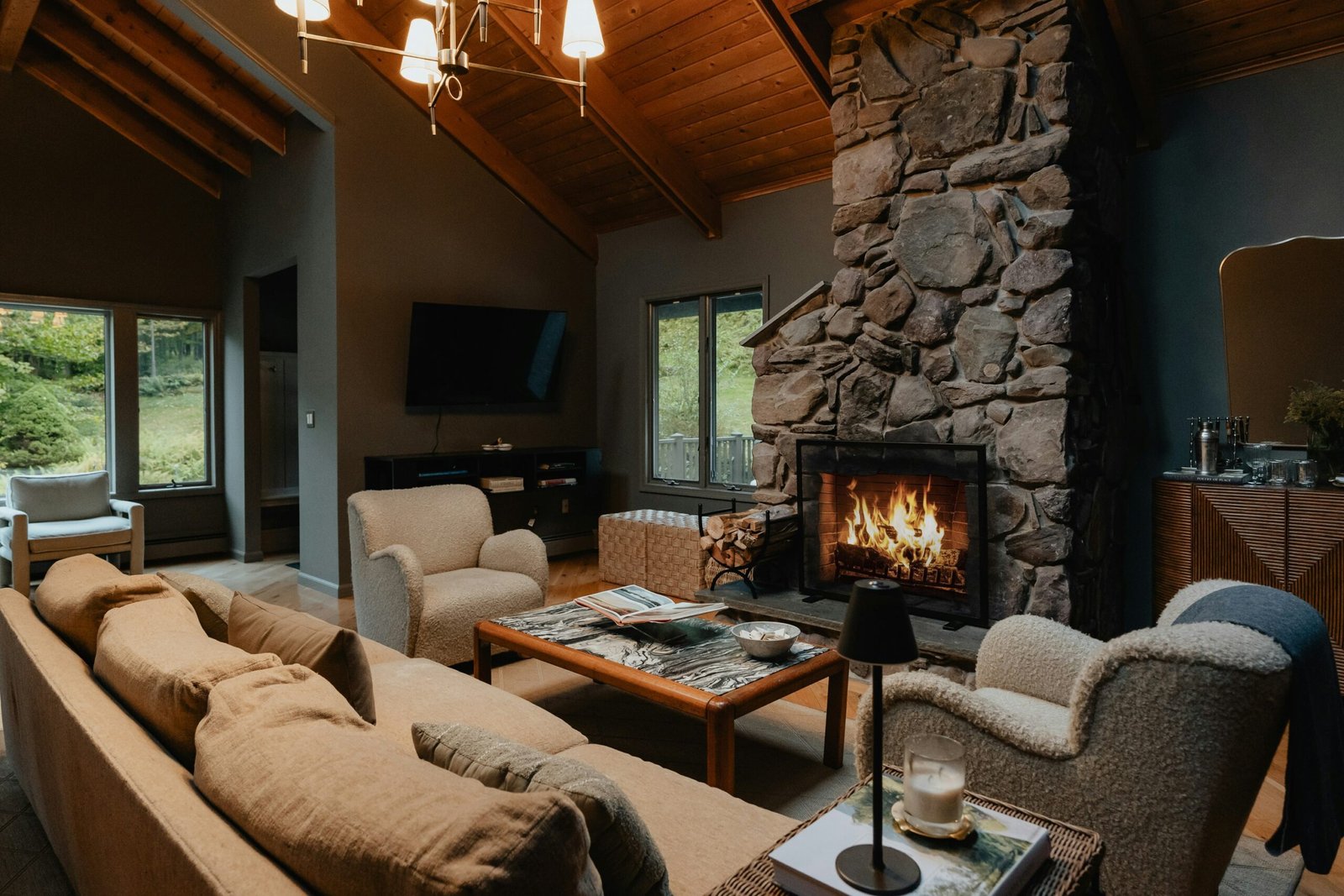
Arrange your seating so every seat has a direct sightline to the fire. That usually means a sofa facing the fireplace flanked by two chairs at slight angles — a classic configuration that works in almost any room size. Pull furniture closer to the fire than you think you need to — the common mistake is pushing everything back against the walls, which creates a cold, empty center and makes conversation feel like a shouting match.
If you’re building or rebuilding a fireplace surround, go with natural stone over manufactured stone veneer when budget allows. The texture, variation, and weight of real stone is visible and tactile in a way manufactured stone never fully replicates. Fieldstone, limestone, and ledgestone are all excellent choices for a cabin aesthetic. For more on fireplace design, check out our Outdoor Fireplace Ideas post.
Styling the mantle: The mantle is the most important styling surface in the whole room. Keep it simple and layered — a few meaningful objects rather than a crowded collection. A vintage antler mount at center, flanked by a pair of heavy pillar candles in iron holders, with a simple wooden tray holding a few natural objects — pinecones, river stones, a small botanical print — is a combination that’s hard to beat. Rotate it seasonally and it never gets stale.
2. Choose a Dark, Warm Color Palette
Nothing kills a cabin living room faster than the wrong paint color. White walls might work in a beach house or a modern loft. In a hunting cabin, they read as unfinished and cold — like the decorating never got started.
The right palette for a hunting cabin living room is dark, warm, and grounded in nature. Think deep forest green, warm charcoal, rich tobacco brown, aged cognac, and the warm creams you find in natural linen and undyed wool. These colors make a room feel like it wraps around you — which is exactly the feeling you want after a long cold morning in a deer stand.
My go-to color combinations for cabin living rooms:
- Dark green walls + warm wood tones + cream textiles: This is the classic hunting lodge palette and it works for a reason. Benjamin Moore’s Tarrytown Green or Sherwin-Williams’ Hunt Club are excellent starting points.
- Charcoal walls + leather + amber accents: More masculine and dramatic. Works beautifully in a room with a lot of natural light. The amber accents — throw pillows, lampshades, candle holders — mirror the fire.
- Warm brown walls + plaid + natural stone: The most traditional cabin combination. Feels like it’s been there for decades even when it’s brand new.
Paint the ceiling too. I know that sounds intimidating but a cabin living room with white ceilings and dark walls looks unfinished. Take the dark color up onto the ceiling — or go with a warm white that reads cream rather than bright. The room will feel complete in a way it simply doesn’t with stark white overhead.
3. Layer Textiles — The Fastest Way to Add Warmth
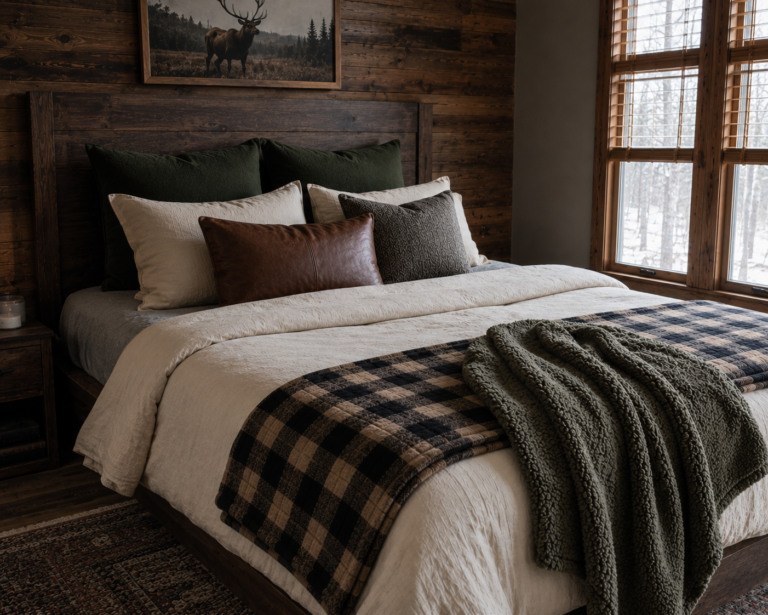
Walk into any cabin living room that feels irresistibly cozy and I guarantee there are layers. Multiple throw blankets draped over chair arms and sofa backs. A thick wool rug anchoring the seating area. Chunky knit pillows mixed with leather ones. A plaid wool blanket folded on the ottoman.
Textiles are the fastest and most affordable way to transform a cabin living room. You don’t need new furniture. You don’t need to repaint. Swap out your throws and pillows and add a rug and the room is a completely different experience.
Textiles that work in a hunting cabin living room:
- Wool plaid throws — the most classic cabin textile. Buffalo check, tartan, and houndstooth all work. Go for heavyweight wool rather than acrylic — it looks and feels completely different.
- Leather throw pillows — mix with woven or linen pillows for texture contrast. Tobacco, cognac, or dark chocolate leather reads as expensive and lasts forever.
- A thick wool or jute area rug — the rug defines the seating area and anchors the furniture. Go bigger than you think you need. The most common rug mistake in any room is going too small.
- Chunky knit blankets — the modern cabin staple. Natural oatmeal or cream colored, draped casually over the arm of a leather sofa, they add texture and warmth without any effort.
- Cowhide rug as an accent — layered over a jute base rug, a cowhide adds incredible texture and a genuine connection to the land that feels right in a hunting space.
Mix patterns intentionally — plaid with solid, check with texture. The rule of thumb is one large-scale pattern, one medium-scale, one solid. Three patterns of similar scale fight each other. Three patterns of different scales work together.
4. Display Trophy Mounts the Right Way
Let’s talk about the thing everyone’s thinking about in a hunting cabin living room — the mounts. Done well, trophy displays are one of the most compelling and personal design elements a cabin can have. Done poorly, they look like clutter on a wall and make guests uncomfortable.
The difference is almost entirely about intention and restraint.
Rules for displaying trophy mounts well:
Create a gallery wall rather than random placement. Group mounts together in a considered arrangement rather than scattering them across every available wall. A curated grouping of three to five mounts — varying antler size and species — on one feature wall reads as intentional. The same number spread randomly across four walls reads as chaos.
Mix mounts with other elements. A trophy mount surrounded by empty wall space looks lonely and clinical. Surround it with vintage hunting prints, aged wooden signs, antique maps of your hunting grounds, or framed photos from the field. The mount becomes part of a story rather than just a head on a wall.
Consider European mounts for a cleaner look. European skull mounts — just the cleaned skull and antlers, without the hide — have a more modern, sculptural quality that works in both rustic and contemporary cabin spaces. They’re also significantly less expensive than full shoulder mounts.
Choose the right hanging height. Mount at eye level or just above — not up near the ceiling where nobody can see them. Eye level means the bottom of the mount is roughly at 57–60 inches from the floor, which is standard gallery hanging height.
One statement mount beats ten mediocre ones. If you have a truly exceptional rack — a deer or elk that meant something — give it the wall space it deserves. One dominant mount on a feature wall flanked by smaller supporting elements is more powerful than a wall crowded with every mount you’ve accumulated.
5. Invest in a Quality Leather Sofa
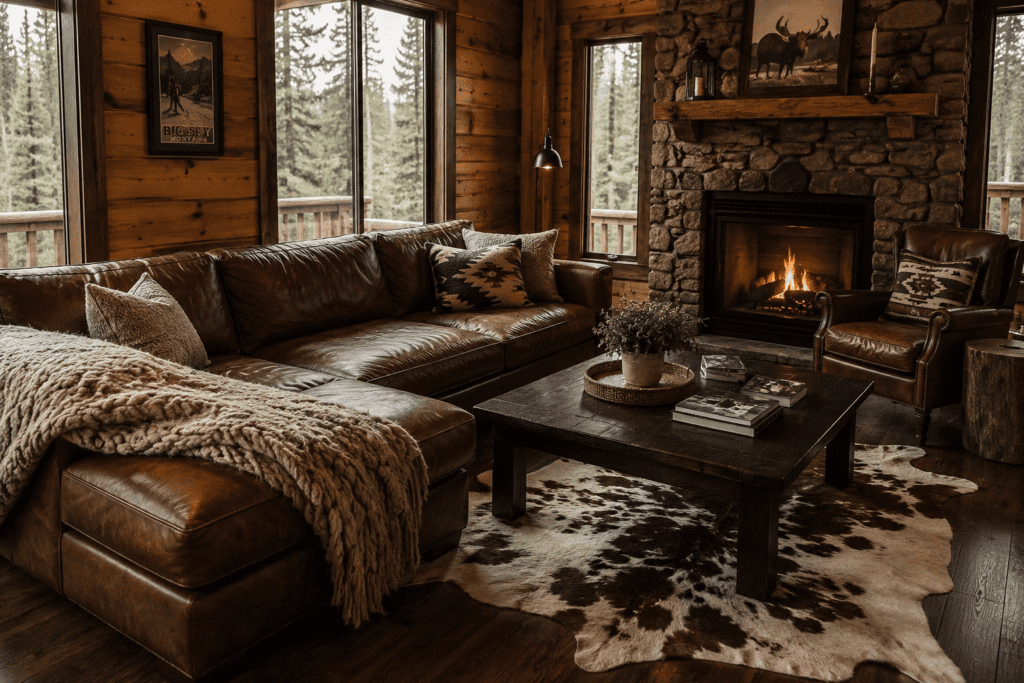
If there’s one furniture investment that will transform a hunting cabin living room more than anything else, it’s a quality leather sofa. Not faux leather. Not bonded leather. Full-grain or top-grain genuine leather in a warm, dark tone — cognac, tobacco, dark brown, or aged saddle.
Here’s why leather works so well in a cabin living room. It ages beautifully — the longer you have it, the better it looks. It’s easy to clean — a hunting cabin sofa gets used hard, and leather wipes down rather than absorbing stains. It’s durable enough to last decades. And the color and texture of aged leather is one of the warmest, most inviting things you can put in a room.
The style that works best in a hunting cabin context is a classic rolled-arm or track-arm sofa in a substantial size — 84 to 96 inches — with simple, clean lines. Tufting can work in a more formal lodge setting. For a casual hunting camp, keep it simple.
Pair it with:
- A chunky wool throw in buffalo check draped over one arm
- Two leather throw pillows in a slightly different tone
- A worn cowhide rug layered over jute in front of it
- A dark wood and iron coffee table at a comfortable height
This combination — leather sofa, wool throw, cowhide, dark coffee table — is the foundation of almost every great hunting cabin living room I’ve ever seen.
6. Use Wood Everywhere — But Vary the Finish
Wood is the backbone of cabin interior design. But the mistake I see constantly is using the same wood finish on every surface — matching the floor to the ceiling to the furniture to the trim. Everything blends together and the room looks flat and staged rather than layered and lived-in.
The secret is using wood everywhere while varying the finish, tone, and texture. Light wood floors with dark wood ceiling beams. Smooth milled wood walls with rough-hewn furniture. Reclaimed barn wood on one accent wall against painted shiplap on another.
Wood elements that transform a cabin living room:
Exposed ceiling beams — if your cabin has them, celebrate them. If it doesn’t, faux wood beams have gotten remarkably realistic and the impact they have on a room is dramatic. Dark stained beams on a cream ceiling make a room feel twice as substantial.
Shiplap accent wall — one wall of horizontal shiplap in a warm natural wood tone anchors the room and gives you a backdrop for your fireplace, media center, or trophy display. Paint it a deep color for drama or leave it natural for warmth.
Reclaimed wood coffee table — a thick slab of reclaimed timber on iron pipe or hairpin legs is one of the most characterful pieces you can put in a cabin living room. It tells a story before anyone sits down.
Wood panel ceiling — tongue-and-groove pine ceiling boards in a warm honey or amber stain do something to a room that’s hard to describe. It feels like being inside the forest. On a hunting cabin, that’s exactly right.
7. Get the Lighting Right — Three Layers, Always
Lighting is the most overlooked element in cabin interior design and the one that makes the biggest difference when you get it right. A hunting cabin living room that’s lit entirely by a single overhead fixture looks institutional and harsh. The same room lit with three layers of warm light feels like the coziest place on earth.
The three layers of lighting for a cabin living room:
Ambient lighting — the overall fill light for the room. In a cabin, this should come from multiple sources at different heights rather than one overhead fixture. Recessed lights on a dimmer, a large lantern-style pendant over the seating area, or a combination of both. Keep the color temperature warm — 2700K is the sweet spot for cabin spaces.
Task lighting — reading lamps beside the sofa and chairs for practical use. Table lamps with dark iron or bronze bases and linen shades work perfectly. The shade color matters — white shades cast cool light, natural linen or cream shades cast warm light.
Accent lighting — the layer that does the most atmospheric work. Picture lights above your trophy wall, LED strip lighting in a bookshelf, candles on the mantle, a string of Edison bulbs on the porch visible through the window. These points of warm light are what give a room depth and drama after dark.
The goal is a room that gets progressively warmer and more intimate as the evening goes on. Overhead lights dimmed, lamps on, candles lit, fire going. That progression is what makes people lose track of time in a well-designed cabin living room.
8. Create a Reading Nook or Dedicated Sitting Corner
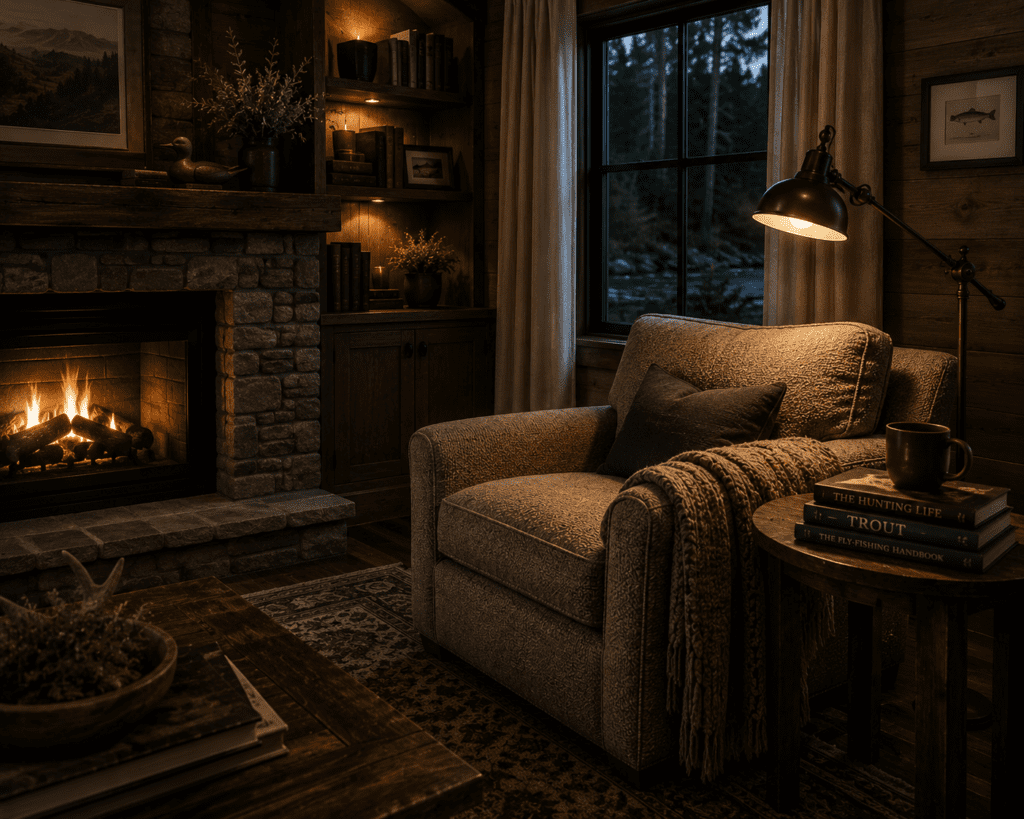
The best cabin living rooms have a spot that feels like it’s just for one person — a deep armchair angled toward the fire with a side table, a reading lamp, and a small stack of hunting and fishing books within reach. It’s the spot everyone fights over.
This doesn’t require a lot of square footage. A single wingback or club chair with wide arms, positioned at a 45-degree angle to the fireplace in a corner of the room, with a floor lamp arching over it and a small wooden side table — that’s the whole setup. Maybe 25 square feet of floor space.
Chair styles that work best in a hunting cabin living room:
- Leather club chair — the classic. Pairs with the leather sofa without being too matchy.
- Wingback in tartan or plaid wool — traditional, warm, and full of character. The high back and sides create a feeling of enclosure that’s perfect for a reading spot.
- Oversized linen chair — softer and more casual. Works well if the rest of the room is leaning darker and heavier.
Add a stack of coffee table books on the side table — Field & Stream archives, Aldo Leopold’s A Sand County Almanac, a big photography book of North American landscapes — and the corner tells a story about who uses the space.
9. Add a Vintage or Antique Element
Every great cabin living room has at least one thing that isn’t new. A vintage element — something with age and history — gives a space authenticity that no amount of new furniture can replicate.
It doesn’t have to be expensive or precious. An old wooden decoy on a shelf. A vintage canvas creel hung on the wall. A collection of antique fishing lures in a shadow box. An aged topographic map of your hunting grounds framed above the mantle. A set of old hunting prints in mismatched frames clustered together.
These objects tell the story of a life lived outdoors. They’re conversation starters. They make the space feel inhabited and personal rather than decorated.
Places to find great vintage hunting and fishing pieces:
- Estate sales — the best source for genuine vintage outdoor gear and prints
- Antique markets and flea markets — especially in rural areas
- eBay and Etsy — wider selection but harder to assess condition
- Your own family — old gear from a father or grandfather is the most meaningful vintage element in any hunting cabin
One vintage element, placed thoughtfully, does more for a cabin living room than a room full of new things trying to look old.
10. Build in Storage — For the Stuff That Actually Lives There
A hunting cabin living room accumulates stuff. Gear that didn’t make it back to the mudroom, dog leashes, hunting licenses, field guides, binoculars, pocketknives. If the room doesn’t have a place for all of it, it ends up on every surface and the space always looks cluttered no matter how well designed it is.
Built-in storage flanking the fireplace is the most elegant solution — floor-to-ceiling shelving on either side of the chimney creates storage, display space, and architectural symmetry all at once. Build it from rough-sawn lumber stained dark, add simple iron hardware, and it looks like it’s been there since the cabin was built.
If built-ins aren’t in the budget, a large wooden trunk used as a coffee table solves multiple problems at once — it’s a surface, extra seating, and storage for blankets and extra gear. A reclaimed wood media console with closed lower cabinets keeps electronics and clutter hidden. Open shelving on one wall with a mix of books, baskets, and decorative objects keeps things organized while looking intentional.
11. Hang a Large-Scale Map
This is one of those ideas that sounds simple and turns out to be one of the most impactful things you can do in a cabin living room. A large-scale topographic or illustrated map of your hunting and fishing grounds — or simply the region your cabin sits in — hung above the sofa or fireplace becomes the focal point that tells the whole story of the place.
Vintage USGS topographic maps are available online for most regions and can be printed large-format at a local print shop for under $50. Frame it in a simple raw wood frame and it looks incredible. An illustrated fishing map of a local lake or river — the kind that shows fish species, depth contours, and landmarks — is equally striking and deeply personal.
This is an inexpensive, deeply personal design element that you genuinely cannot buy at a furniture store.
12. Choose the Right Rug — Bigger Than You Think
The rug in a hunting cabin living room does three things: it anchors the seating area, adds warmth underfoot, and connects all the furniture into a unified grouping. Get it right and the room feels complete. Get it wrong and the furniture looks like it’s floating.
The most common mistake is going too small. In most living rooms, you need a rug that’s large enough for at least the front legs of all the seating furniture to rest on it. For a standard living room with a sofa and two chairs, that means a minimum of 8×10 feet — and a 9×12 is usually better.
Rug materials that work in a cabin living room:
- Wool — the best option for warmth, durability, and authentic cabin feel. Natural fiber, ages beautifully, cleans reasonably well.
- Jute — extremely durable, natural texture, works as a base layer under a cowhide or as a standalone in a more casual space.
- Cowhide — dramatic, unique, genuinely connected to the outdoor lifestyle. Best layered over a jute base rather than on bare floor.
- Kilim or flat weave — lighter and easier to clean than pile rugs. Good for high-traffic cabin spaces with dogs and muddy feet.
Avoid anything with a high pile in a cabin that gets heavy use — it shows dirt, matts down quickly, and is difficult to clean. Low pile or flat weave handles a hunting cabin’s real life much better.
13. Create a Focal Wall Behind the Sofa
The wall behind the sofa is valuable real estate that most people waste. In a hunting cabin living room, it’s your best opportunity to create a layered, personal display that tells the story of the place and the people who use it.
A gallery wall of framed hunting and fishing photographs — black and white especially — mixed with vintage prints, small antler mounts, a vintage license or permit, and maybe a shadow box of meaningful small objects creates something completely personal and visually compelling. No two are alike. Nobody else has yours.
Elements to mix on a cabin gallery wall:
- Black and white hunting and fishing photos (framed simply in black or natural wood)
- Vintage wildlife prints or duck stamp prints
- A European skull mount or set of shed antlers
- A small chalkboard with a quote, the cabin name, or coordinates
- A vintage wooden sign or carved plank with a meaningful phrase
- A shadow box with fishing lures, spent shells, or other small meaningful objects
The key is mixing frame sizes, mixing frame finishes (not all matching), and varying the scale of objects. The intentional imperfection is what makes it feel genuine.
14. Bring Nature Inside — Plants and Natural Objects
The best hunting cabin living rooms don’t feel separated from the land outside — they feel like an extension of it. Bringing natural objects inside reinforces that connection and adds the kind of organic texture that no manufactured object can replicate.
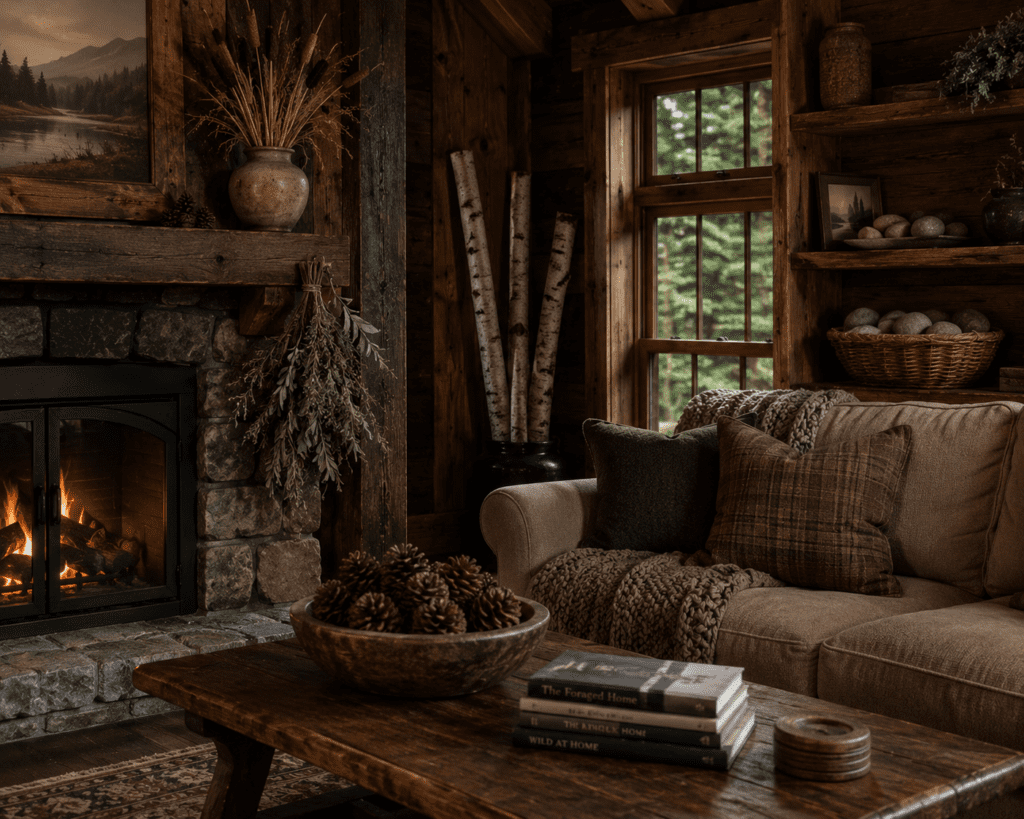
This doesn’t have to be complicated. A few large pinecones in a wooden bowl on the coffee table. A vase of dried wildflowers or cattails on the mantle. A branch of birch with the bark still on leaned in a corner. A basket of smooth river stones on a shelf. A dried arrangement of sage, rosemary, and eucalyptus hung near the fireplace.
Low-maintenance plants that work well in cabin living rooms:
- Pothos — nearly indestructible, drapes beautifully from shelves
- Snake plant — architectural, upright, tolerates low light and inconsistent watering
- Fiddle leaf fig — dramatic when healthy, works in bright natural light near a window
- Dried pampas grass — no maintenance, beautiful texture, lasts for years
If your cabin is only used on weekends or seasonally, stick to dried arrangements and hardy plants rather than anything that needs daily care. A dead houseplant is worse for a room than no plant at all.
15. Design for Real Life — Not the Magazine Photo
The last idea on this list is less about a specific design element and more about a mindset that makes everything else work better.
The best hunting cabin living rooms are designed for how people actually use them — not for how they look in a photograph. That means durable fabrics that can handle dogs and muddy kids. Furniture arrangements that make conversation easy, not just visually symmetrical. Storage solutions for the gear that actually lives in that room. Flooring that doesn’t show every footprint.
Beautiful and functional are not opposing ideas. The most beautiful cabin living rooms I’ve ever been in are also the ones that feel the most lived-in and effortless. Nothing is precious. Nothing is too good to use. Sit anywhere, put your feet up, bring the dog in from the cold.
That’s the feeling you’re designing toward. Not a showroom. Not a magazine spread. A room that feels like the best version of home.
Hunting Cabin Living Room Shopping List
Here’s a quick reference for the key pieces that transform a hunting cabin living room:
| Item | What to Look For | Budget Range |
|---|---|---|
| Leather sofa | Full-grain, cognac or tobacco | $1,200–$4,000 |
| Area rug | Wool or jute, 9×12 minimum | $300–$1,200 |
| Coffee table | Reclaimed wood, iron base | $400–$1,200 |
| Throw blankets | Heavyweight wool plaid | $80–$200 each |
| Table lamps | Iron or bronze base, linen shade | $100–$300 each |
| Throw pillows | Leather + woven mix | $40–$150 each |
| Club chair | Leather or plaid wool | $600–$1,800 |
| Wall art | Vintage prints, maps, photos | $20–$300 per piece |
Conclusion
A great hunting cabin living room doesn’t happen by accident. It happens when someone thinks carefully about how the space should feel, what materials belong there, and how real life — muddy boots, wet dogs, late nights by the fire — will actually use the room.
The hunting cabin living room ideas in this guide aren’t about creating a perfect space. They’re about creating a real one. One that reflects who you are, where you’ve been, and what matters to you. The deer mount on the wall. The vintage map above the sofa. The leather sofa that’s been broken in over a decade of early mornings and late nights.
That’s what makes a hunting cabin living room unforgettable. Not the furniture catalog. The life that happened in it.
Start with one or two of these ideas and build from there. Your cabin doesn’t need to be transformed overnight — the best ones get better slowly, piece by piece, season by season.
Got a cabin living room design you love or a piece that made all the difference in your space? Share it in the comments below.